
The U.S. stock market was essentially flat in July, preserving its approximately 9% year-to-date gain. While the ongoing conflict involving Iran continues to unsettle investors, corporate earnings remain the primary driver of stock prices over the long term.
Oil prices illustrate the market’s sensitivity to geopolitical developments. West Texas Intermediate (WTI) crude oil began July at approximately $70 per barrel, well below its April 2026 peak of $112 per barrel. Renewed hostilities in the Middle East briefly pushed oil prices to nearly $93 per barrel, raising concerns about inflation and global economic growth. As of this writing, however, WTI has retreated to approximately $76 per barrel as optimism has grown that a diplomatic agreement with Iran may be achievable. This recurring cycle of escalating tensions and renewed hopes for de-escalation—particularly regarding shipping through the Strait of Hormuz—continues to be a significant source of short-term market volatility.
The Federal Reserve met in July and voted to maintain the federal funds rate target range at 3.50% to 3.75%. Financial markets initially reacted negatively, reflecting concerns that the Federal Reserve was not taking a sufficiently aggressive stance against inflation. Following the announcement, the Dow Jones Industrial Average fell more than 1,100 points, while the yield on the 10-year U.S. Treasury rose from 4.65% to 4.74%. That reaction proved to be short-lived. Four trading days later, on August 4, 2026, the Dow closed at 54,085—nearly 2,500 points above its post-Federal Reserve low—and the 10-year Treasury yield settled back to 4.60%. Lower oil prices and another round of strong corporate earnings reports helped restore investor confidence.
Corporate earnings continue to be exceptionally strong and remain the foundation of our constructive outlook for equities. Consensus estimates call for S&P 500 earnings to increase approximately 30% in 2026, followed by growth of roughly 12% to 13% in both 2027 and 2028. Historically, annual earnings growth for the S&P 500 has averaged approximately 7% to 8%, making the current outlook well above long-term norms.
A substantial portion of this earnings growth continues to be generated by the seven technology companies commonly referred to as the “Magnificent Seven.” However, the earnings story is becoming increasingly broad-based. Excluding the Magnificent Seven, the remaining 493 companies in the S&P 500 are expected to grow earnings by approximately 22% in 2026 before moderating to roughly 10% in 2027—still comfortably above historical averages.
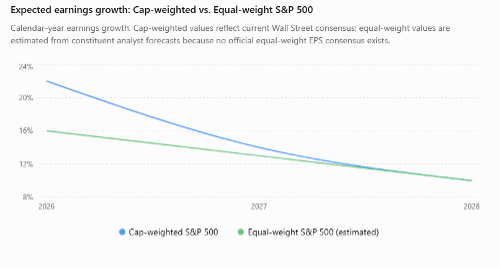
The largest ten companies in the S&P 500 now account for approximately 40% of the index’s total market capitalization, reflecting the index’s capitalization-weighted construction and its concentration to these ten stocks. Looking ahead, consensus forecasts suggest that earnings growth for these largest companies is expected to moderate over the next two years, while earnings growth among the remaining companies is expected to remain comparatively strong. If realized, this would support a broader market advance and improve market participation beyond the largest technology stocks.
Investment in Artificial Intelligence “AI” continues to be massive, with $800 billion in 2026, growing to $1.2 trillion in 2028. AI is already transforming the way individuals and organizations are using the technology to improve productivity. Approximately 49% of individuals use AI currently, up from only 14% three years ago. The adoption uptake has been swift. However, investors are exhibiting concern recently that the level of investment may slow and the return on capital may be well less than expected. This leads me to bifurcate the “builders” and the “users” of AI. As with most transformative technological changes that have occurred, builders tend to build out the technology and oversupply the market. The beneficiaries tend to be the users.
Railroads of the 1800s – supply outstripped demand, driving prices down and forcing many to fail, especially during the financial panic of 1873. The users benefited from the infrastructure: agricultural producers, manufacturers able to bring products to a national market at low shipping costs, and travelers. The failure of Jay Cooke & Company, which held debt of the Northern Pacific Railway, has been associated with sparking a bank run and the financial panic of 1873. Railroads significantly transformed American society and businesses. It was the users, not the builders, that benefited the most.
The automobile Industry of the early 1900s – once again, capital chased this technology, which transformed American society in countless ways, only to oversupply the market.
- 1910 – there were 250-300 automobile manufacturers
- 1920 – only 100-110 companies remained
- 1929 – 70-80 companies were operating
- 1940 – Only 20 companies were operating. The great depression squeezed out the least efficient operators.
The internet build-out of the late 1990s
Internet infrastructure builders go bankrupt- Global Crossing, WorldCom, PSINet, Exodus Communications, and Level3 Communications, among others. Once again, many of the “builders” went out of business due to oversupply, and users thrived and benefited greatly from low-cost internet services. Online banking, cloud-based services, business-to-business communications, retail services, among others, benefited greatly from the extensive low-cost internet services.
And now capital is chasing the very real AI rollout.
As illustrated by the chart below, companies are investing heavily in AI infrastructure and model development. In addition, there is a plethora of companies contributing to data center construction. Data center construction has become controversial as many communities do not want these data centers in their backyard. Various states are already putting restrictions in place.
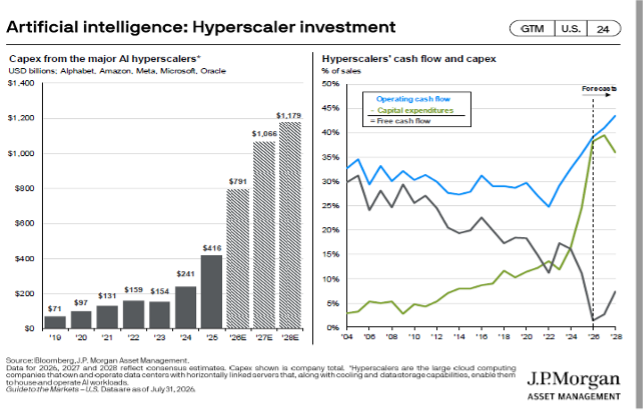
The AI hyperscalers: Amazon, Microsoft, Alphabet (Google), Meta (Facebook), Oracle, CoreWeave, and xAI.
Investment Implications
We believe economic history will once again repeat itself, with AI model builders oversupplying the market, thereby forcing down prices and the return on capital. There will be winners and losers among the model providers, which we will not know until the carnage is exposed. In our opinion, the long-term investment opportunity will be with companies that can develop AI internally and/or use AI models to enhance product and service development and profitability.
Portfolio Construction
1. Safety Funds
As always, we recommend that investors maintain a dedicated “safety bucket” consisting of cash, money market funds, and investment-grade bonds. This reserve should be sufficient to fund spending needs for at least two years, and preferably three to four years. We also recommend limiting bond maturities to five years or less and structuring maturities to align with anticipated spending needs.
2. Equities (Stocks)
Equities are long-term investments and should not be purchased with funds that will be needed within the next several years. Geopolitical and economic events are inherently unpredictable and can trigger significant market declines. While stocks can be volatile over shorter periods, history has consistently shown that they have generated returns well above the rate of inflation over the long term, making them one of the most effective hedges against inflation.
Large-Cap Growth Stocks
Large-cap growth stocks have generated a significant share of overall market returns during the past several years. Companies such as Amazon, Apple, Alphabet (Google), and Nvidia are representative of this market segment. Many of the AI hyperscalers also fall into this category. While we continue to recommend maintaining an allocation to large-cap growth stocks, we are modestly reducing portfolio weightings following their strong performance.
Large-Cap Value Stocks
Large-cap value stocks have lagged growth stocks for the past several years but have experienced a meaningful resurgence in 2026, outperforming their growth counterparts. Improving earnings growth has provided a catalyst for investors to increase allocations to this segment. Many of the companies adopting and deploying AI technologies—the AI “users” rather than the AI infrastructure providers—are found within this category. We currently recommend an overweight allocation to large-cap value stocks.
Small-Cap Stocks
We recommend maintaining a modest allocation to small-cap stocks because of their higher volatility. However, this segment has historically been the source of many of tomorrow’s leading companies and can provide attractive long-term growth opportunities.
International Stocks
Investors can gain international exposure either through U.S.-based multinational companies or by investing directly in non-U.S. equities. Returns from international stocks are driven by corporate earnings growth, valuation changes, and currency movements relative to the U.S. dollar. Looking ahead, we believe interest rates are likely to trend higher over the next year, which could create a headwind for many international equity markets. Accordingly, we favor maintaining only a modest allocation to international stocks at this time.
DISCLOSURE:
Opinions about the future are not predictions, guarantees, or forecasts. Investing in stock and bond markets has risks that could lead to investors losing money. We always advise investors to maintain a cushion of safety funds (cash, money market funds, and investment-grade bonds) to fund expenses for 2-4 years. Unforeseen events occur that can thrust the stock market down. The current Iran Crisis is a perfect example. Stocks are long-term investments and should not be used for short-term spending needs.
Rich Lawrence, CFA August 6, 2026