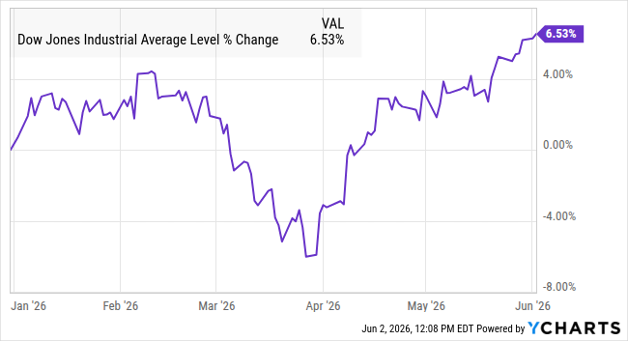
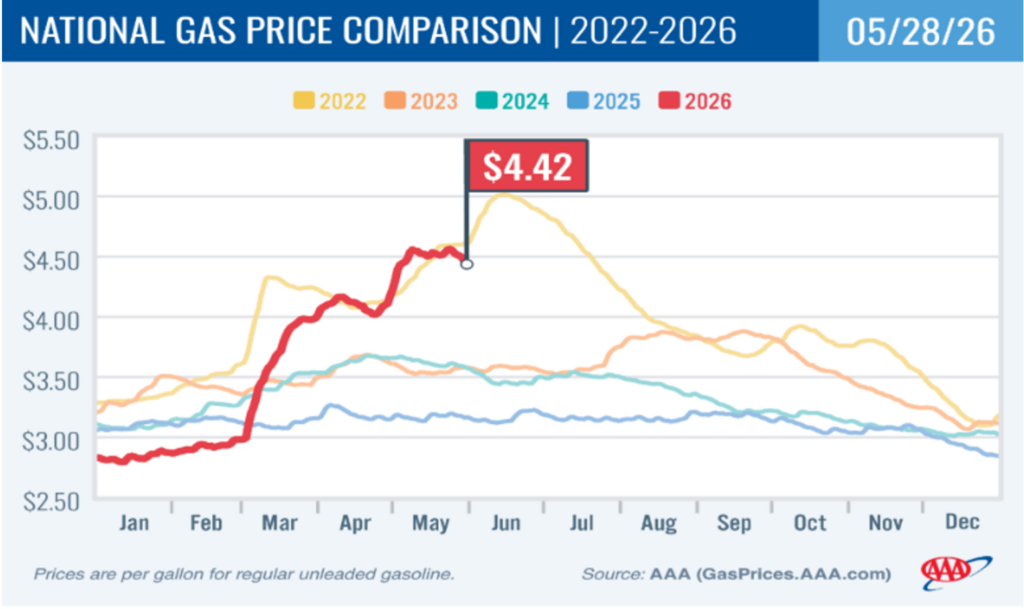
As we all know, the US stock market, as measured by the Dow Jones Industrial Average “DOW”, is at record levels after rebounding swiftly from its March 2026 low of 45,577. The prevailing concern this year has been the rapid rise in gas prices due to the Iran crisis, which has caused an oil supply shock. As the chart below shows, gas prices have surged from under $3.00 per gallon to $4.50. Gas prices have eased slightly during the past ten days; we will see if this trend continues or reverses back up. Oil prices and the stock market are responding swiftly to any announcements relating to the Iran crisis.
The consumer is “hanging in there”, while business investment has been extraordinarily strong. In April 2026, personal spending was up 0.5% (month-to-month). With inflation up 0.4% in April, real spending was up only 0.1%. The average tax refund check is $3,500, clearly helping consumer spending. Bank of America reported in mid-May that credit and debit card spending in April was up 4.8%, and 4.0% excluding gas. During the past two weeks, however, retail and consumer-sector reports indicated shoppers were becoming more selective and value-oriented. We expect consumer spending to remain under pressure while gas prices remain elevated. Consumer spending continues to expand, but momentum appears to be moderating. Once the refund check stimulus dissipates, consumer spending may decline in real terms unless gas prices and inflation decline. However, technology spending, especially artificial intelligence “AI”, has been strong.
Corporate profits growth in record territory – Q1 2026 +28% and full year 2026 expected +23%. Investors are expecting well above average earnings growth for 2026-2028. Profit margins are generating the lion’s share of this growth, which is expected to continue. For the 2026 through 2028 period, earnings for the S&P 500 Index companies are expected to expand by an incredible 58%! The explosive growth in productivity and earnings should result in wages growing more than inflation and thereby improving standards of living.
Risks and Concerns
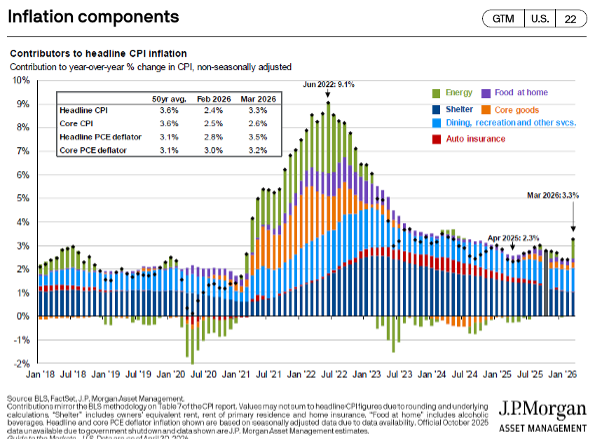
Inflation and gas prices – Consumer sentiment as measured by the University of Michigan’s “Consumer Sentiment Index” is at an historic low due to inflation since 2020, and especially the 2021-2024 period, and the recent spike in gas prices. Inflation has moderated in the past two years but remains well above the Federal Reserve’s 2% target.
The chart to the right clearly illustrates the surge in inflation, especially during the 2021-2024 period. This spike in inflation was due in large part to the FED printing dollars to finance the US deficit, in my opinion.
Investment Strategy
While we remain optimistic about the outlook for corporate earnings growth and the stock market, we are realists and are aware that these estimates could be reduced. Investing in the stock market should be viewed as long-term with a three to four-year+ time horizon.
Therefore, we recommend maintaining a “safety bucket” of funds, including cash, money market funds, and investment‑grade bonds, to cover at least two years of expenses, and ideally 3-4 years. This approach allows you to withstand normal market fluctuations without disrupting your financial plan.
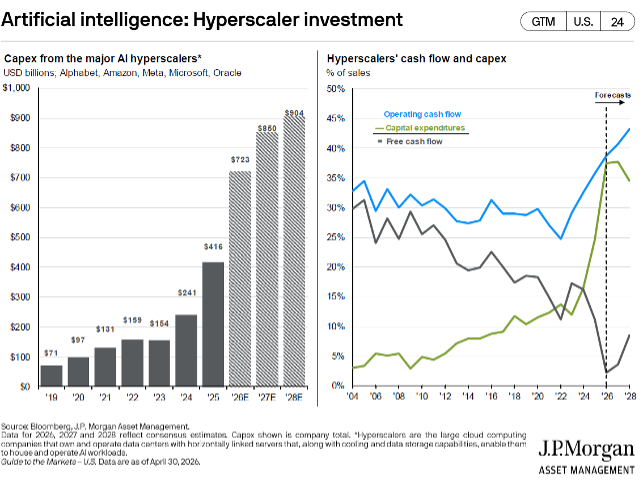
The artificial intelligence “AI” technology revolution is real and being adopted swiftly. As the graph to the right illustrates, the AI hyperscalers have the cash flow to fund AI and are planning more than $700 billion of AI investment in 2026 and close to $1 trillion in AI capital expenditures “cap x” in 2028.
As with all new transformative technologies, an abundance of capital chases these innovations. There will be winners and losers after the initial surge.
There are builders and users of AI. We believe it is prudent to reduce exposure to the “builders” (the chip and data center builders) and position investment portfolios to the “users” of AI, which should benefit from enhanced productivity and profitability.
DISCLOSURE:
Opinions about the future are not predictions, guarantees, or forecasts. Investing in stock and bond markets has risks that could lead to investors losing money. We always advise investors to maintain a cushion of safety funds (cash, money market funds, and investment-grade bonds) to fund expenses for 2-4 years. Unforeseen events occur that can thrust the stock market down. The current Iran Crisis is a perfect example. Stocks are long-term investments and should not be used for short-term spending needs.
Rich Lawrence, CFA June 5, 2026