Investor uncertainty started almost immediately when military operations began on February 28th.
- The stock market, as measured by the Dow Jones Industrial Average “DOW”, is down 10% from its 52-week high and thus is in a correction. On a year-to-date basis, the DOW is down 6%.
- Iran choked off the Strait of Hormuz, restricting the free flow of cargo, especially oil, to the world market. The price of WTI oil is $104 a barrel, up from $65 before the conflict. Gas prices are up approximately $1.00 per gallon, a 33% increase.
- Opening the Strait of Hormuz will be necessary to get oil from the Persian Gulf back on the market. Once this happens, we expect the price of oil to begin its descent and the market to start to recover.
- No one knows when the conflict will be resolved. The economic pain is being felt globally, including China, which imports 40-50% of its oil from the Persian Gulf and has influence over Iran. The US has influence over China as it is China’s largest consumer market. We do expect there to be both diplomatic and military forces that should result in ratcheting down the conflict, and in particular, to open the Straits of Hormuz.
- According to a study conducted by Fidelity Investments, negative market reactions based on geopolitics have tended to be short-lived. The research looked back to Pearl Harbor through the Russian Invasion of Ukraine in 2022. The research shows that equity markets recover in the 12 months following the event with an average 8% gain, roughly the same as equities’ long-term annual averages.
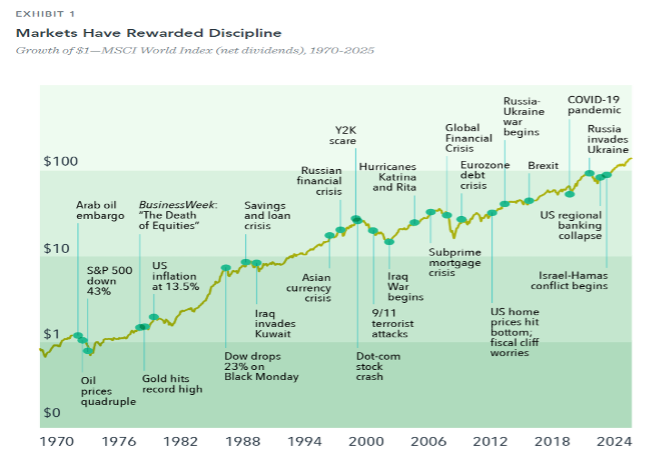
The following chart illustrates the S&P 500 Index over time with various events noted.
We all remember….
- COVID
- Financial Crisis 2008-2009
- Signature Bank Failure 2023
- Russian Ukraine War
- Trump Tariff Announcement April 2025
- Y2K Scare- 1999
Economic and Investment Implications
- Economic growth for 2026 to slow in our opinion – Most economists estimate US GDP for 2026 to be in the 1.8-2.2% range. In contrast, on March 18th, the Federal Reserve updated its economic forecast, which included an increase of its GDP forecast for 2026 from 2.3% to 2.4%. We expect GDP growth to contract somewhat until the Iran Crisis subsides, and the price of oil begins to decline.
- Surprisingly, S&P 500 corporate earnings growth remains well above trend at 15% for 2026 and 2027. Historically, corporate earnings have grown 7-8% annually. Economic productivity, driven in part by artificial intelligence (AI) in the US, is generating much of this earnings growth.
- Interest rates rise; bond prices decline as the “oil shock” causes inflation concern in the bond market.
This current market correction is precisely why we advise clients to maintain safety funds (cash, money market funds, and investment-grade bonds) to fund cash needs for at least 2 years, and preferably 3-4 years.
Portfolio Construction
Portfolio allocations are tailored to each client’s goals and risk tolerance. Currently, we are emphasizing large-cap value and dividend-paying stocks, while gradually reducing exposure to large-cap growth.
Exact allocations vary based on individual risk profiles and anticipated cash needs over the next 2–4 years. For those near-term needs, we recommend using “safety” assets such as money market funds and investment-grade bonds.
Rich Lawrence, CFA
Disclosure: Lawrence Wealth Management LLC and Richard Lawrence make no guarantees, warranties, or predictions. Investors can lose money investing in capital markets.